Wet Paint
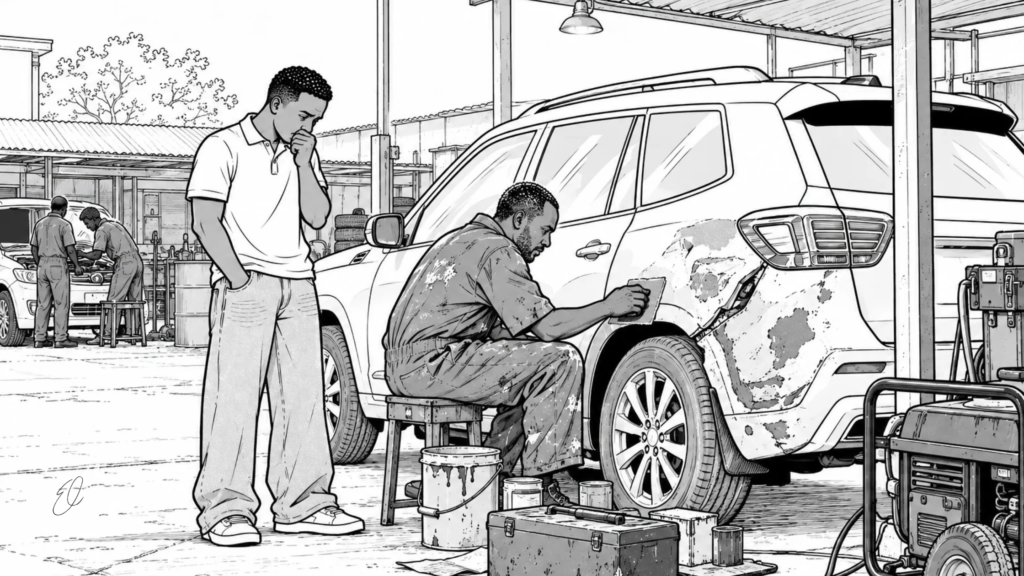
“Hello, hello, hello.” Wale raised his hand to shut down the persistent pleading of the labourers. “I said, who is the manager on this site?”
It was all crickets. Joke fixed her eyes on Wale, anticipating the worst.
“Are you guys deaf? I said, who is the site manager, abi you guys want me to change it for una?”
The men remained quiet. At this point, Joke had folded her arms and was looking the other way. She did not really like drama. She was hoping things would smoothen out and that it would not get so loud that her dad would step out of the house. She also felt bad for Wale. Deep in her heart, she felt he was in this quagmire because of her.
“Babe, I’m so sorry.”
Wale did not respond. His eyes were fixed on an elderly man in Ankara. A black polythene bag was folded and tucked underneath his armpit. The labourers deferred to him, so Wale immediately realised he was the man he was looking for.
“Hello. How are you? What is the matter?”
The man looked like a former president of the country. Tribal marks, pot belly, probably in his late sixties.
“Good afternoon.” Wale bent his head slightly.
Joke bent her knee slightly.
The man had already seen the damage. The look he gave his men was more than enough. Some of them would not be getting their wages that day.
Wale had other problems in front of him.
“Sir, what’s going to happen?”
The man did not respond immediately. He walked over to the damaged side of Wale’s mum’s jeep to inspect it.
“I’m Chief Akinola Onigbinde. Sorry I didn’t introduce myself. You are?”
Wale introduced himself, and so did Joke.
“Which Olaleke is that? The same one from Ikenne?”
Wale was not sure where this was headed. Time was running out, and his mother’s car had to be fixed, whatever it took. He did not want to be rude, but at the same time, he wanted to establish the urgency of getting his mum’s car fixed.
“I grew up in your grandfather’s church. He was such a great man of God. Authentic, powerful, and filled with unusual grace. His ministry is what the body of Christ is missing in Nigeria today.”
While Joke was getting carried away, fascinated by the man’s stories, Wale had adjusted his posture about a hundred times while the man was talking.
“Sir, we will have to fix this car right now,” Wale interjected with a straight face.
Joke gave him a look, not sure what to make of Wale’s posture.
“Sure, sure. This is a very new car, I suppose it would have insurance?”
Wale’s patience had grown thin.
“Sir, this car doesn’t belong to me, and I need to return it tonight in one piece. Time is running out. We need to act fast now.”
“Indeed,” the man said slowly.
The man had figured it out. A young man who had taken his parent’s car out for a spin gone wrong.
He took a glance at his watch, then, seconds later, gave an instruction.
“Follow me. I know a panel beater around the corner.”
“Please, let’s move swiftly before he closes. This car has to be fixed tonight.”
“Well, I can’t guarantee that, but let’s get to the workshop first.”
Wale bid Joke farewell. There was nothing romantic about it. His mum’s car was the priority.
So he drove behind the man.
The same tipper truck that had done the damage was the one leading the way.
They finally got to the mechanic village. Wale looked around. The men were all rounding off or were already dressed and ready to go home.
Wale could feel the heat.
“Baba oh.”
That was the greeting from the man the project manager approached. He was still wearing his oil- and dirt-stained jumpsuit but looked like he had retired for the day.
The project manager explained what had happened, and he casually suggested that the car stay the night there and that he would resume the panel beating the next day.
Wale protested. That was the loudest his voice had ever rang out. He was having none of it. Every time the panel beater or his apprentice tried to get into his mum’s car for something, he stopped them and offered to assist if they needed anything from inside the car. He could not afford a stain or foul body odour on or in his mum’s cream interior.
“Waheed, I have never asked you for a favour before. Do me this one favour. How much do you need to get this done, even if it means working into the night?” the project manager pleaded.
The panel beater came with more excuses. From needing a generator to needing fuel to light up his corner, because the workshop management would never switch on the generator after 6 p.m. The project manager sent for a generator from his site, along with fuel. The panel beater eventually caved.
“There’s one more problem, sir. The painter has closed and gone home,” he said in Yoruba.
The project manager had to take a seat at this point, rubbing his temple.
“There’s no other painter in this big workshop?” he asked.
The panel beater assured him that it was best they stuck with this particular painter, the only one he could vouch for when it came to repainting a fairly new vehicle.
“Give me his number,” the project manager asked.
He had a lot of convincing to do.
The man had a good reputation, it seemed. Every member of the mechanic shop who walked by took time to greet him specially.
Wale noticed.
No wonder he was able to convince the painter.
But the painter could not make it that evening. He only assured the project manager that he had secured a pint of the car’s paint shade.
All the conversations were on speaker, so Wale could hear it all.
It was now getting late.
The project manager had to leave.
“I have paid them to get the job done. I will have to take my leave now. You heard when the painter said he will be here first thing in the morning by 6 a.m.”
Wale kept his eyes on the time, ensuring his mother’s car was parked in the house before 8:30 a.m., when his mum would leave for church.
He collected the man’s number and the painter’s.
Soon, the panel beater was done with his own task, and he had to leave with his boys.
Only Wale and the security guards were left in that big mechanic workshop.
The mosquitoes had a field day.
The chorus the insects were singing in his ears was much louder than any cartoon skit he had watched on TikTok. He felt their bites instantly. It was almost as though infants were taking turns.
He barely had three minutes of uninterrupted sleep.
Once it was 5:30 a.m., he had started calling the project manager, who had reassured him that the painter would be there as promised.
The painter, true to his word, showed up.
But there was another problem. It started raining. Wale looked to the heavens, questioning many of his choices.
He insisted that the painter proceed with the painting despite the painter’s protests.
“Look, we are under the shade. The rain can’t get here. I really need to get this car back before 8 a.m. The owner is meant to travel with it this morning,” he lied.
As the downpour intensified, the painting continued.
The work was done. The time was now 7:15 a.m.
His mum would be awake now, heading to the shower. Wale thanked the painter profusely and sped off. The good news was that the rain had stopped and the sun was out. He was home in fifteen minutes. The engine oil on the gate’s hinges was still doing its job. The gate opened with ease and no noise. Next was to wash the car. He avoided the newly painted area. He needed to get rid of any sign that the car had left the house. He used a hand fan to try to speed up the drying of the car paint for a while before going upstairs. He had changed into his home clothes and stashed his bag in the flower beds outside.
“What were you doing downstairs? I came to your room to ask if you’ve seen my car keys. I don’t know where my keys are. I’ve picked the spare one anyway. Aren’t you going to church?”
“Third service, Mum. Let me help you with your bag while you sort out other things.”
It was a deliberate attempt to keep his mum at bay so that if she quizzes him about the heat of the car’s bonnet, he would claim he just warmed the car.
And she was off to church.
Wale lay his head down to sleep and recover from the drama and mosquito onslaught.
He was barely twelve minutes in when his phone rang.
He picked up.
“Wale! Why do I have wet paint on my car?”