THE LAST GUEST
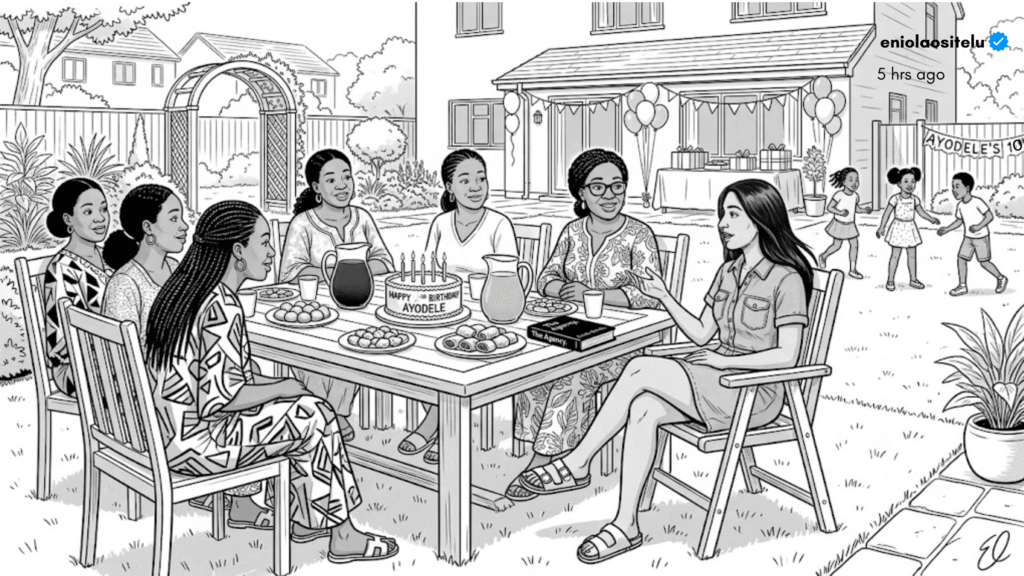
Busola had just got off the phone with her sister Lamide when it happened. The call came just in time; Lamide was already on her way over.
Today was her son Ayo’s tenth birthday, and it was a big deal. As the first grandchild on either side of the family, Busola’s in-laws had already hinted, loudly, that they were coming in their numbers. If she wanted proof of how many to expect, the credit alerts landing in her account all week were confirmation enough.
Dayo, her husband, had pushed for the party to be held at an amusement park close to the estate. His reasons were practical: no washing up, no clearing up after, none of the mess that wore a hosting family down long after the guests had gone. Busola countered with her mum’s health, and her mother-in-law’s. Besides, their garden was big enough for everyone: the kids, the adults, the women, friends and family.
Ayo, the celebrant, woke up to five-star pampering. His parents had exceeded every item on his gift list. There wasn’t one favourite character toy he’d asked for that he didn’t get. Ben 10, Teen Titans Go, Spider-Man. A laptop, at last. New Air Jordans. A replica Inter Miami jersey with Messi’s number 10 on the back. Even his annoying younger sisters were unusually kind to him. It was barely 9am, and if he’d had a genie, his one wish would have been for this day to never end. There was still so much to look forward to: more gifts, his cousins, the party games, the school friends he’d invited.
Every parent had RSVP’d but one. Aarav, his friend from the science club, a tight-knit little circle the boys cherished, was the one most likely not to show. That was the only thing that hadn’t gone to plan.
Busola, now the same height as her ten-year-old son, laid her hands on his shoulders.
“Look, I don’t want you getting your hopes up, okay? I’ve spoken to other mums who’ve organised parties, and they say his family hardly ever comes. It’s okay. They probably have their reasons.” She let it settle. “Look on the brighter side. All your friends from the club are coming, your cousins Tomisin, Segun and Laide are coming, and look at all those gifts you got today. Plus, your grandmas are on their way. C’mon, baby, it’s going to be a great day.”
She hugged him, and he ran off to the bathroom.
The day turned out to be just as anticipated. The caterer arrived on time, and the food was good too. Think of any delicacy you’d find at a Nigerian owambe, it was there. The kids took over their corner of the garden, having the time of their lives. The DJ, the MC, the games, the Spider-Man and Iron Man mascots. The list went on. The parents had their own corner where they watched the proceedings, though the MC made sure they weren’t left out of the games entirely. The grandmas watched from not too far away.
As the party wound down and the crowd began to thin, Lamide tapped the shoulder of an exhausted Busola, following her gaze to see what had caught her attention. Busola, peering through her thick glasses, could hardly believe it. It was Aarav, his younger sister, and his mum. How timely. Funny how all the boys still left at the party were from the science club.
The boys ran to embrace Aarav, while his mum smiled bashfully, one hand covering her mouth. Priya was her name. Slim, pretty, curvy, and polite. The dads sat on one side; she took her place among the mums, barely speaking, smiling, her gaze following whoever spoke.
Busola put her on the spot. “I’m really honoured you came, Priya. Ayo was already upset that Aarav wasn’t going to show up. Thanks again.”
Priya flushed. She was embarrassed being the centre of attraction again. Busola made sure she felt at ease. “Please relax. You’re among your sisters, I assure you.”
Nodding repeatedly, smiling, Priya finally spoke, her Hindi accent clear. “Thank you for inviting us. I think this is the first party we have attended in a long while. Aarav made it very clear he wanted to be here. Let me use this opportunity to apologise to the other mothers who have sent us invitations before. I don’t want anyone thinking we cherry-picked this party.” She adjusted herself and continued, explaining her peculiar situation.
Most weekends, when the invites came, only one of her children would be invited. With no babysitter, and being a housewife, the other automatically couldn’t go. Secondly, the official driver only worked weekdays. Since she couldn’t drive, and her husband forbade her from taking Ubers except in emergencies, she and the children simply stayed home.
“That’s why we made it to Michaela’s birthday. My husband, back from the rig was home that day. For this one, both children were invited, so I begged my husband to arrange overtime for the driver to bring us. That’s…”
Her daughter came around and interrupted her, speaking in their local dialect. Priya responded in kind, a short exchange but a fluent one. The other mothers watched, intently.
“I’m so sorry, friends. She can be quite something.” The other mums shrugged it off like nothing happened.
Nneka, one of the curious mums asked, “what did she want, by the way?” Priya laughed. “Oh, it’s nothing, just a silly request. She wants to take one of the mascots home.”
The mothers all laughed.
“She speaks your language so fluently. How old is she?” Busola asked.
Priya chuckled. “Oh, that? She’s only three. It’s the same with Aarav. We always speak Hindi to them at home.”
Another curious mother, Jadesola, leaned in. “Aren’t you worried they won’t have a great command of English?”
Priya shook her head, her face still playful. “They’ll catch up on that later. They spend more hours in school, with teachers and other pupils, than anywhere else. And most of the cartoons they watch are in English.” She said it so simply, as if she didn’t realise she was teaching the other mothers a lesson in preserving their own culture. “In fact, when Aarav was his sister’s age, whenever my husband and I wanted to gossip without him understanding, we spoke in English.”
The Nigerian mums looked at each other, almost as if they were asking themselves the very same question. Here they were, parents from different cultural backgrounds, all raising children in Lagos, and not one of them could confidently say their child could introduce themselves in their own dialect. It was a reality check long overdue, and every one of them knew it.
Busola’s only regret was that the grandmothers were listening too.